



One hobby, a thousand benefits. Behind every ham radio contact is a chain of science: electromagnetic waves, antenna geometry, electronics, signal processing and mathematics. That is why amateur radio is one of the most natural gateways into STEM – Science, Technology, Engineering and Mathematics. The infographic below, Radio Amatur & STEM: Connecting, Learning, Innovating, Future – Building the Digital Generation 2027, sets out how our hobby can help Malaysia nurture the next generation of engineers, technicians and innovators.
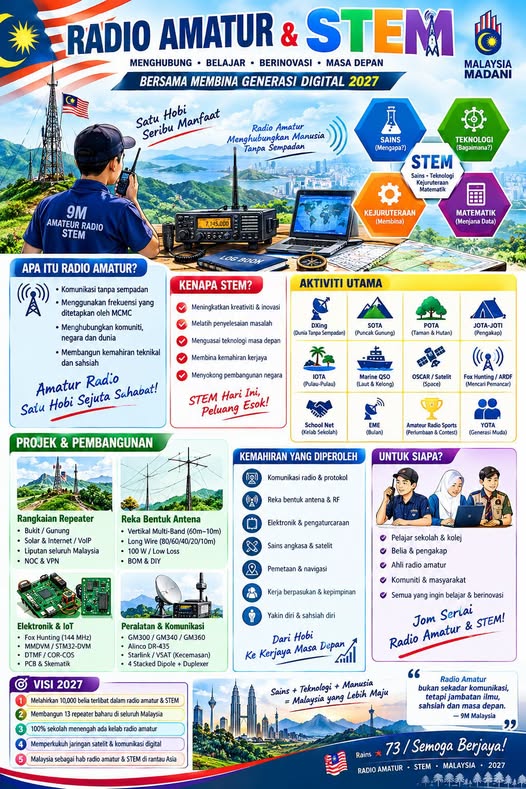
Click the image for the full-size infographic.
What is Amateur Radio?
Amateur radio (ham radio) is wireless communication carried out by licensed enthusiasts on frequencies allocated for the purpose. According to the ARRL, it is a service for self-training, personal enjoyment and public service – never for commercial gain. The service is recognised internationally by the International Telecommunication Union (ITU) and coordinated worldwide by the International Amateur Radio Union (IARU). In Malaysia, frequencies and licensing are regulated by the Malaysian Communications and Multimedia Commission (MCMC).
In short: communication without borders, on frequencies set by MCMC, connecting communities, nations and the world while building technical skills and goodwill.
Why STEM?
Amateur radio turns textbook theory into something you can hear, build and test. Operators and students alike gain:
- Creativity and innovation – building antennas and circuits from scratch;
- Problem-solving – finding why a signal is weak, noisy or absent;
- Future-ready technology skills – RF, digital modes, embedded systems and networking;
- Career pathways – telecommunications, electronics, aerospace and IT;
- National capability – a pool of technically skilled, service-minded citizens.
The ARRL’s STEM education resources and ARISS (Amateur Radio on the International Space Station), which lets students speak directly with astronauts, show how effective this approach is around the world.
How STEM Maps to Ham Radio
| STEM pillar | In amateur radio |
|---|---|
| Science (What is it?) | Radio waves, the ionosphere, propagation, space weather |
| Technology (How does it work?) | Transceivers, digital modes, repeaters, satellites, SDR |
| Engineering (Build it) | Antenna design, power systems, PCBs, enclosures, tower safety |
| Mathematics (Make sense of the data) | Wavelength and frequency, SWR, decibels, link budgets |
Core Activities
The infographic highlights the activities that make the hobby exciting for young people and seasoned operators alike:
- DXing – contacting distant stations across the globe.
- SOTA (Summits on the Air) – activating mountain peaks with portable gear. See sota.org.uk.
- POTA (Parks on the Air) – operating from parks and nature reserves. See parksontheair.com.
- JOTA-JOTI – the Scouts’ annual Jamboree on the Air and Jamboree on the Internet. See jotajoti.info.
- IOTA (Islands on the Air) – island activations. See iota-world.org.
- Marine QSO – contacts with stations at sea.
- OSCAR / satellite – communicating through amateur satellites, coordinated by AMSAT.
- Fox hunting / ARDF – radio direction finding, a sport that blends navigation and RF. See ARRL – ARDF.
- School Net – scheduled on-air sessions with school radio clubs.
- EME (Earth–Moon–Earth) – bouncing signals off the Moon. See Moonbounce.
- Amateur radio sports and contesting – see ARRL Contests.
- YOTA (Youngsters on the Air) – programmes that bring young hams together.
Projects and Development
Repeater network
Hilltop or mountain sites, solar power, Internet/VoIP linking and wide coverage across the country, supported by a network operations centre (NOC) and VPN links. A repeater is the backbone of VHF/UHF coverage and an important asset during emergencies.
Antenna design
Practical, low-cost builds: a vertical multiband antenna covering 60 m to 10 m, and long-wire antennas for 80/60/40/20/10 m. Projects at around 100 W are ideal for classroom and club work, complete with a bill of materials (BOM) and DIY instructions. Antenna theory is well documented in ARRL’s antenna resources.
Electronics and IoT
Fox-hunting transmitters on 144 MHz, digital voice hardware such as MMDVM and STM32-DVM, DTMF controllers and COR/COS interfaces, and printed circuit board (PCB) design with schematics – hands-on electronics with direct application.
Equipment and communications
Practical club equipment such as commercial-grade VHF/UHF radios (for example the GM300/GM340/GM360 series and Alinco DR-435), Starlink/VSAT for resilient connectivity, and stacked dipole arrays with duplexers for repeater sites.
Skills Gained
Participants build radio communication and protocol knowledge, antenna and RF design, electronics and programming, space science and satellite awareness, mapping and navigation, teamwork and leadership, and — just as importantly — self-confidence and discipline. It is a journey from hobby to future career.
Who Is It For?
- School and college students
- Youth and scouts
- Existing amateur radio operators
- Communities and the public
- Anyone who loves learning and innovating
The 2027 Vision
The infographic lays out a five-point vision for 2027:
- Involve 10,000 youths in amateur radio and STEM;
- Develop 13 new repeaters across Malaysia;
- Reach 100% of schools with awareness of, or access to, a radio club;
- Strengthen satellite and digital communication networks;
- Position Malaysia as an amateur radio and STEM hub in Asia.
These are ambitious targets, and they will need partnerships between clubs, schools, agencies and industry. The path is clear: begin with awareness, support it with training and licensing, then sustain it with projects that keep young people on the air.
Licensing and Safety
Any on-air activity must be carried out by operators with valid certification and callsigns, using only authorised frequencies and power levels. Visitors and students without a licence may take part under the direct supervision of a licensed operator. Always follow tower, grounding, electrical and RF-exposure safety practices, and check current rules directly with MCMC.
Join In
Whether you are a student curious about how a signal reaches the other side of the world, a teacher planning a STEM day, or a veteran operator ready to mentor, there is a place for you in amateur radio. Reach out to JASRA and your local club to get started.
Science + Technology + People = a more advanced Malaysia. 73 & good luck!
References: ARRL – What is Ham Radio? · ARRL – STEM Education · ARRL – Antennas · ARRL – ARDF · ARRL – Contests · ARISS · AMSAT · IARU · ITU · MCMC · SOTA · POTA · IOTA · JOTA-JOTI


