



Bahasa Melayu dahulu, diikuti versi English. · Malay first, followed by the English version.
Teleskop James Webb & Skala Sebenar Alam Semesta — dan apa kaitannya dengan gelombang radio
Baru-baru ini tular sebuah artikel bertajuk “James Webb Telescope Just Announced The True Scale of the Universe”. Tajuknya hebat, dan memang benar: sejak mula beroperasi pada 2022, Teleskop Angkasa James Webb (JWST) telah mengubah cara kita melihat saiz dan usia alam semesta. Dalam tulisan ini kami menulis semula kisah itu dengan fakta yang telah disemak, dan sebagai sebuah persatuan radio amatur kami bawa satu sudut tambahan: cahaya yang dilihat oleh Webb sebenarnya “sepupu” kepada gelombang radio yang kita gunakan setiap hari di jalur HF, VHF dan UHF.
1. Mengenali Webb secara ringkas
| Pelancaran | 25 Disember 2021, roket Ariane 5 dari Kourou, Guiana Perancis (kerjasama NASA, ESA dan CSA) |
| Lokasi | Titik Lagrange L2 Matahari–Bumi, kira-kira 1.5 juta km dari Bumi (≈4 kali jarak ke Bulan) |
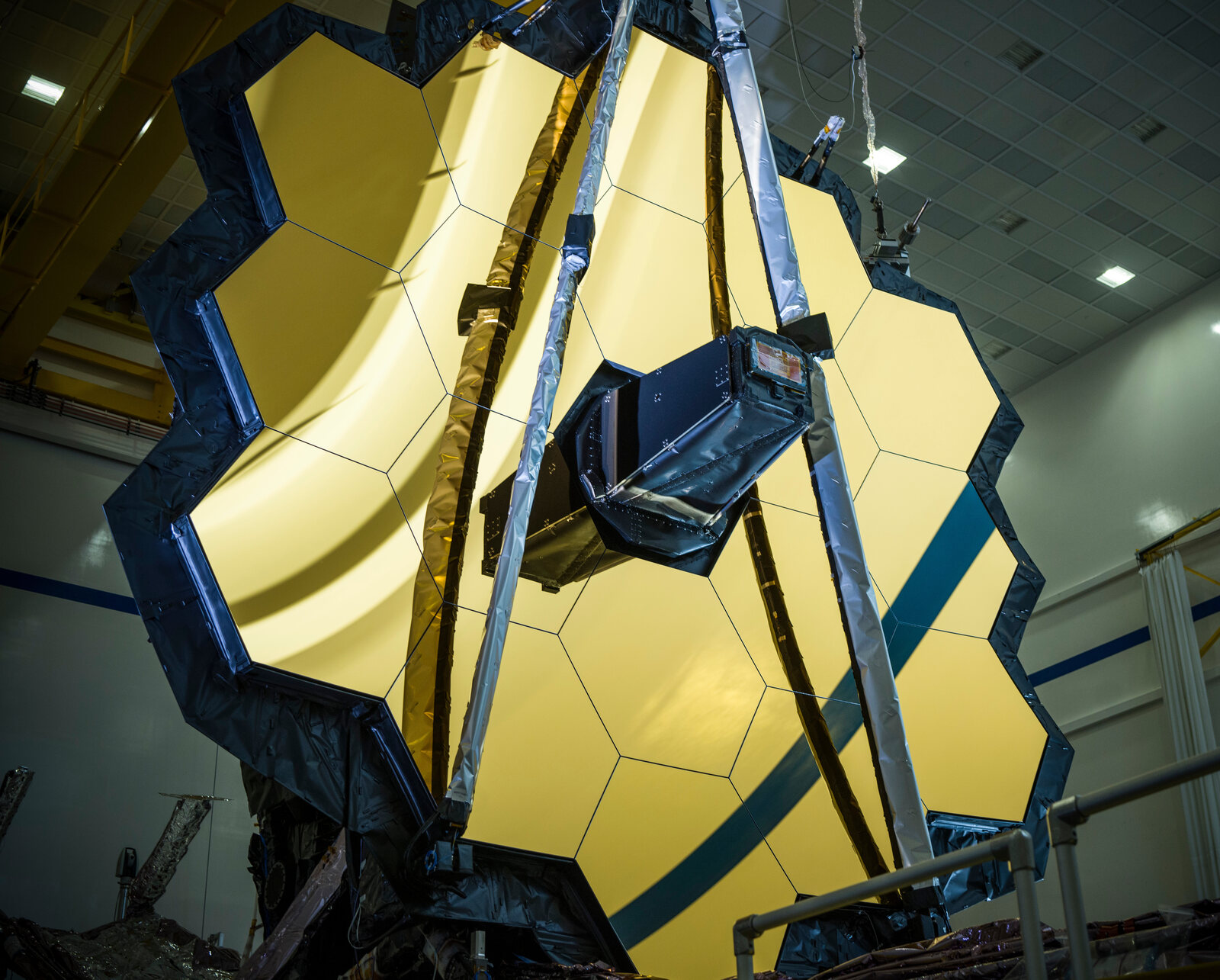
| Cermin utama | 6.5 m, 18 segmen berilium bersalut emas (emas memantulkan inframerah dengan sangat baik) |
| Pelindung matahari | 5 lapisan, lebih kurang sebesar gelanggang tenis (≈21 m × 14 m) |
| Suhu kerja | Di bawah −223 °C; instrumen MIRI disejukkan hingga sekitar −266 °C (7 K) |
| “Mata” | Inframerah 0.6–28.5 mikrometer (µm) — iaitu frekuensi kira-kira 500 THz hingga 10.5 THz |
Kenapa inframerah? Kerana cahaya daripada galaksi yang paling jauh telah “diregang” sepanjang perjalanannya merentasi alam semesta yang mengembang, sehingga cahaya ultraungu dan cahaya nampak bertukar menjadi inframerah. Webb mesti sangat sejuk supaya haba badannya sendiri tidak “membutakan” pengesannya — sama seperti penerima radio yang memerlukan penguat hingar rendah (LNA) untuk mendengar isyarat lemah.
2. “Sebutir pasir sepanjang lengan”: Medan Dalam Pertama Webb
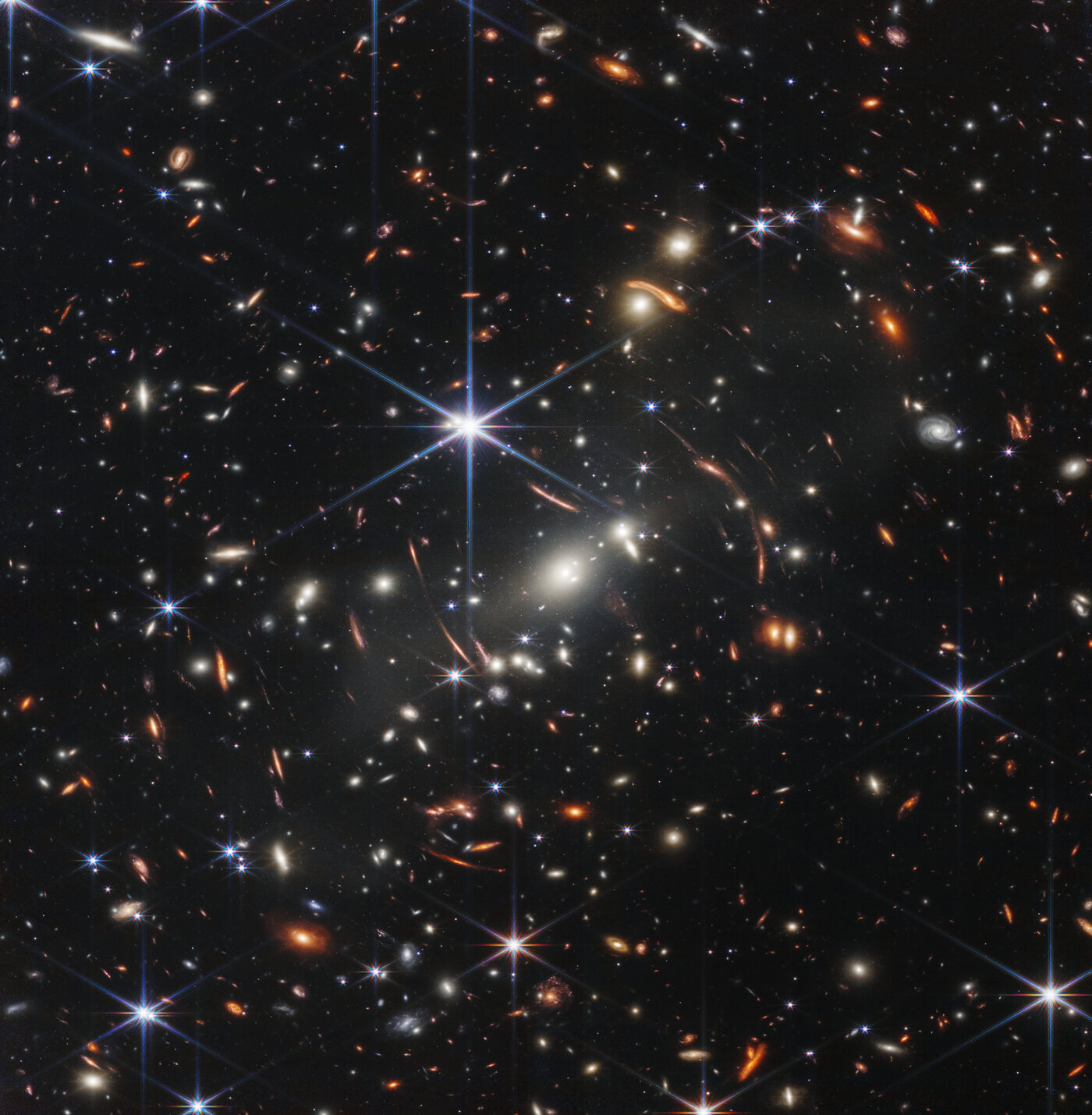
Pada 12 Julai 2022, dunia melihat imej penuh warna pertama Webb: gugusan galaksi SMACS 0723. Bahagian langit dalam imej itu hanya sebesar sebutir pasir yang dipegang sepanjang lengan — namun ia dipenuhi ribuan galaksi. Gugusan itu dilihat seperti keadaannya 4.6 bilion tahun dahulu, dan jisimnya yang besar bertindak seperti kanta pembesar (kanta graviti) yang membengkokkan dan membesarkan cahaya galaksi lain yang jauh lebih tua di belakangnya. Gambaran ini baru diperoleh selepas kira-kira 12.5 jam cerapan — sesuatu yang memerlukan berminggu-minggu bagi teleskop terdahulu.
3. Rekod galaksi paling jauh: MoM-z14
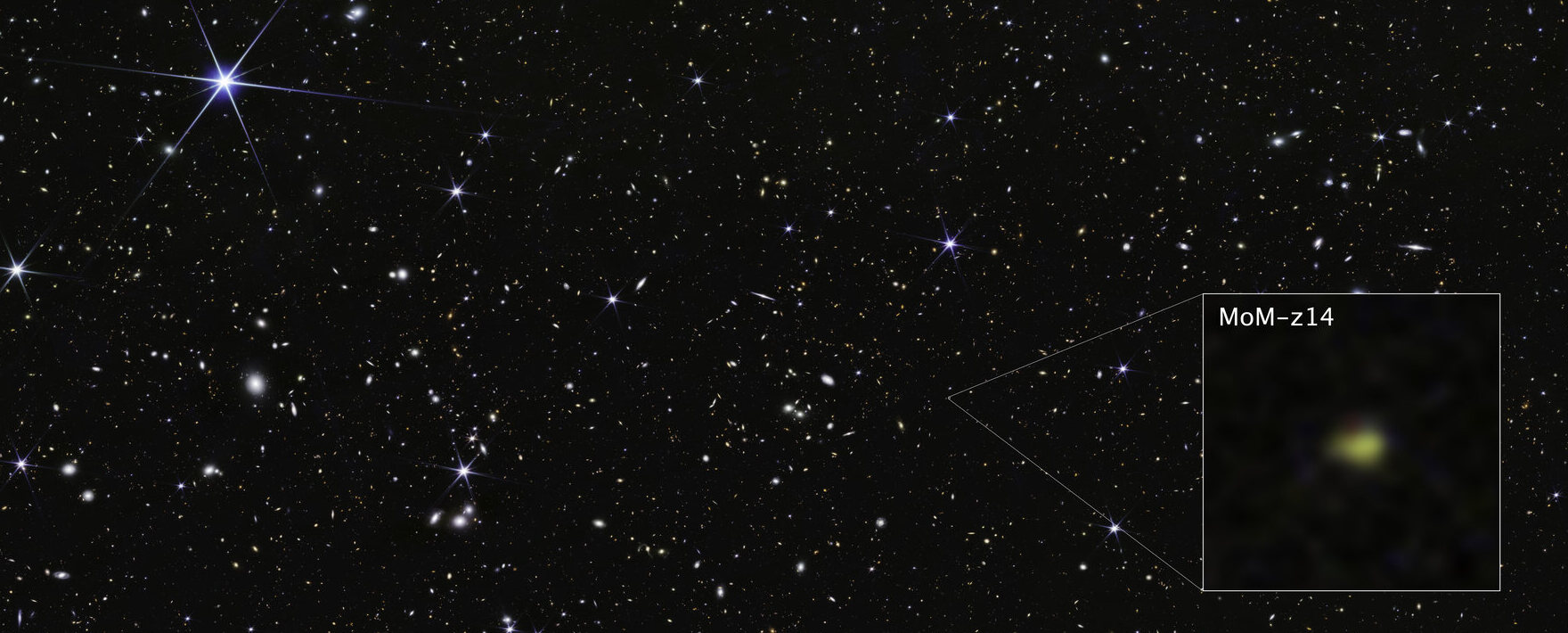
Webb terus memecahkan rekodnya sendiri. Pada 2024, galaksi JADES-GS-z14-0 dilaporkan sebagai yang paling jauh. Kemudian galaksi MoM-z14 disahkan dengan instrumen NIRSpec pada anjakan merah z = 14.44: cahayanya telah mengembara selama kira-kira 13.5 bilion tahun, dan kita melihatnya ketika alam semesta baru berusia lebih kurang 280 juta tahun. Menurut pasukan penyelidik, galaksi seterang ini di zaman awal adalah kira-kira 100 kali lebih banyak daripada jangkaan teori sebelum Webb dilancarkan. Itulah “kejutan” sebenar: bukan Letupan Besar yang salah, tetapi model tentang betapa cepatnya bintang dan galaksi pertama terbentuk perlu dikemas kini.
4. Skala sebenar: 13.8 bilion tahun, tetapi 93 bilion tahun cahaya lebarnya
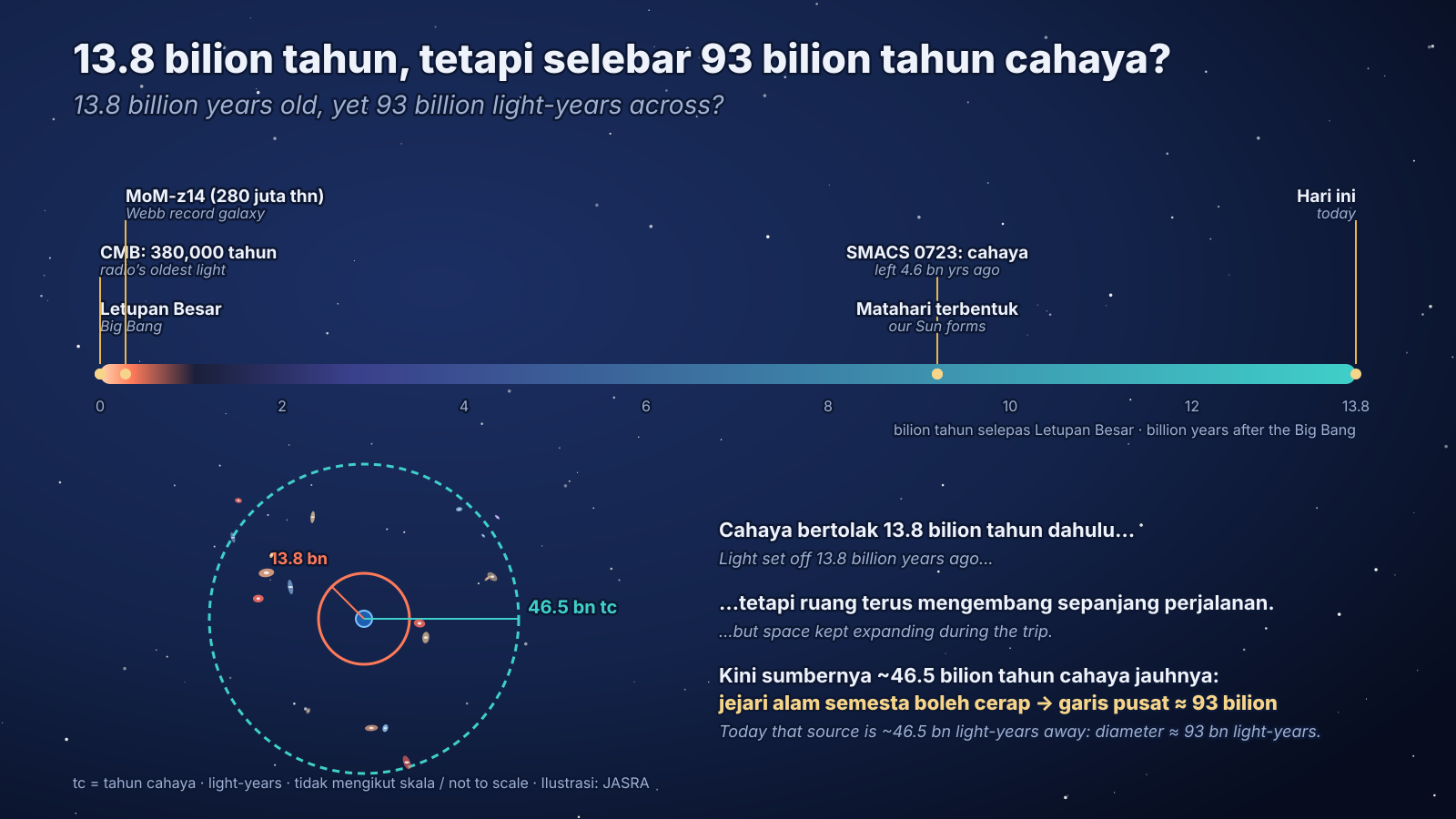
Alam semesta berusia kira-kira 13.8 bilion tahun. Jadi bagaimana alam semesta boleh cerap (observable universe) mempunyai garis pusat kira-kira 93 bilion tahun cahaya? Jawapannya: ruang itu sendiri terus mengembang ketika cahaya sedang dalam perjalanan. Cahaya yang bertolak 13.8 bilion tahun dahulu datang daripada bahan yang kini sudah berada kira-kira 46.5 bilion tahun cahaya dari kita (jejari), maka garis pusatnya ≈ 93 bilion tahun cahaya. Dan itu hanyalah bahagian yang boleh kita lihat — alam semesta keseluruhannya mungkin jauh lebih besar, malah mungkin tidak terbatas.
5. Berapa banyak galaksi sebenarnya?
Artikel asal menyebut “trilion, bukan 200 bilion”. Faktanya lebih menarik daripada itu: pada 2016, kajian berdasarkan data Hubble menganggarkan sehingga 2 trilion galaksi dalam alam semesta boleh cerap; pada 2021 pula, ukuran kecerahan latar langit oleh kapal angkasa New Horizons mencadangkan jumlahnya mungkin “hanya” beberapa ratus bilion. Webb kini mengira galaksi yang sangat malap dan jauh secara langsung, membantu menyelesaikan perbezaan ini. Jawapan muktamad belum ada — tetapi apa jua angkanya, setiap galaksi mengandungi berbilion bintang. Ini juga contoh sains yang baik: anggaran diperbaiki apabila alat ukur bertambah baik.
6. Apa kaitannya dengan radio? Satu keluarga gelombang
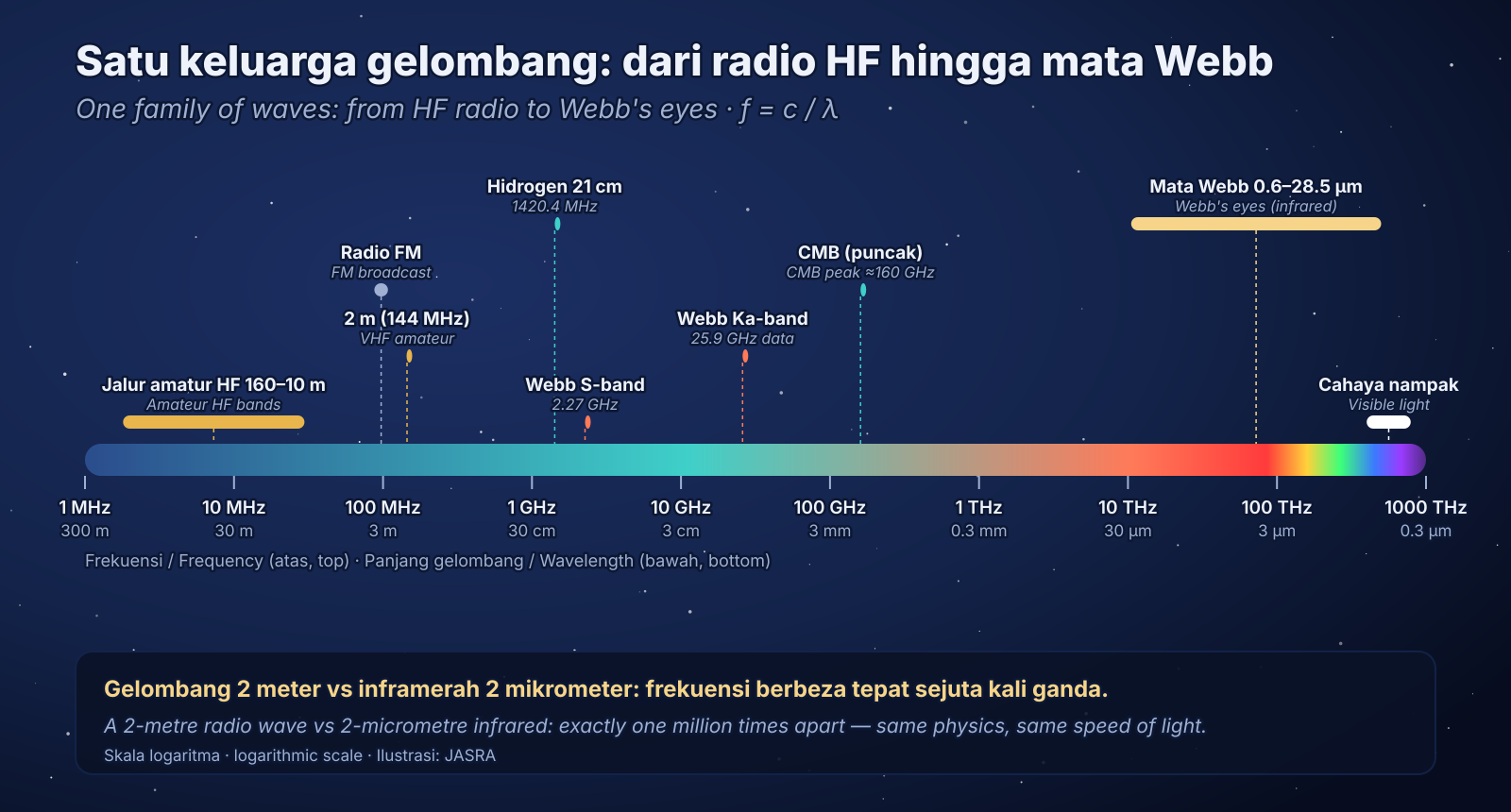
Bagi pengendali radio amatur, inilah bahagian paling menyeronokkan. Cahaya, inframerah dan gelombang radio adalah gelombang elektromagnet yang sama, bergerak pada kelajuan cahaya (c ≈ 300,000 km/s). Yang berbeza hanyalah frekuensi dan panjang gelombang, dihubungkan oleh formula yang kita semua hafal untuk mengira antena:
f = c / λ · contoh: 300 / 145 MHz ≈ 2.07 m (jalur 2 meter)
Instrumen NIRCam Webb mencerap sekitar 2 mikrometer — tepat sejuta kali lebih pendek daripada gelombang jalur 2 meter kita, iaitu kira-kira 150 THz berbanding 145 MHz. Fizik yang sama, cuma “dial” yang berbeza.
7. Anjakan merah = kesan Doppler yang kita kenal
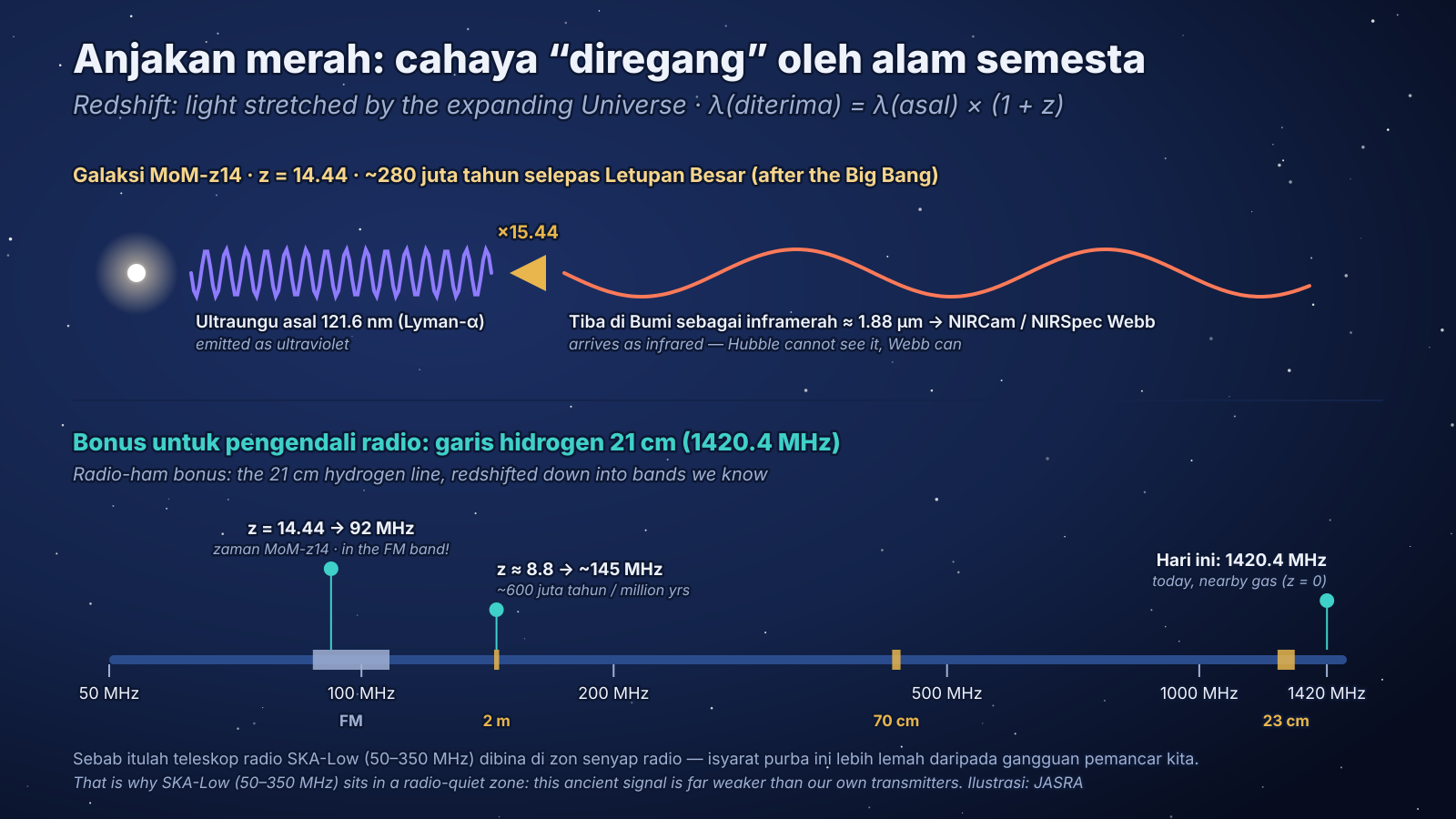
Sesiapa yang pernah membuat QSO melalui satelit atau ISS tahu tentang anjakan Doppler: frekuensi downlink ISS 145.800 MHz berubah sehingga kira-kira ±3.5 kHz semasa ia melintas, kerana ia bergerak laju ke arah dan menjauhi kita. Anjakan merah kosmologi hampir serupa konsepnya — cuma ia berlaku kerana ruang itu sendiri mengembang dan meregangkan gelombang. Formulanya mudah: λ diterima = λ asal × (1 + z).
- Bagi MoM-z14 (z = 14.44), cahaya ultraungu Lyman-alfa 121.6 nm diregang 15.44 kali menjadi kira-kira 1.88 µm (inframerah). Hubble tidak dapat melihatnya; Webb boleh.
- Garis hidrogen neutral yang terkenal di kalangan ahli astronomi radio, 1420.405 MHz (21 cm), dari zaman yang sama akan tiba di Bumi pada sekitar 92 MHz — betul-betul dalam jalur radio FM!
- Hidrogen dari zaman kira-kira 600 juta tahun selepas Letupan Besar (z ≈ 8.8) pula tiba sekitar 145 MHz — di jalur 2 meter kita.
Itulah sebabnya teleskop radio generasi baharu seperti SKA-Low (50–350 MHz, lebih 130,000 antena di Australia Barat — zon waktu yang sama dengan Malaysia, UTC+8) dibina di kawasan “senyap radio”. Isyarat hidrogen purba ini jauh lebih lemah daripada pemancar FM, televisyen — dan juga pemancar kita. Jalur 1400–1427 MHz pula dilindungi di peringkat antarabangsa (ITU): tiada sesiapa dibenarkan memancar di situ, demi astronomi radio.
8. Cahaya tertua dikesan oleh antena radio
Satu lagi kisah yang dekat di hati pengendali radio: pada 1964–65, dua saintis Bell Labs, Arno Penzias dan Robert Wilson, mengesan “hingar” misteri pada 4.08 GHz menggunakan antena tanduk mereka. Hingar itu datang dari semua arah, siang dan malam. Rupa-rupanya itulah Sinaran Latar Gelombang Mikro Kosmik (CMB) — cahaya tertua alam semesta, dipancarkan 380,000 tahun selepas Letupan Besar dan kini diregang menjadi gelombang mikro (puncaknya sekitar 160 GHz). Mereka menerima Hadiah Nobel Fizik 1978. Sebahagian kecil “semut” pada skrin TV analog lama sebenarnya ialah gema Letupan Besar ini!
9. Bagaimana Webb menghantar data ke Bumi
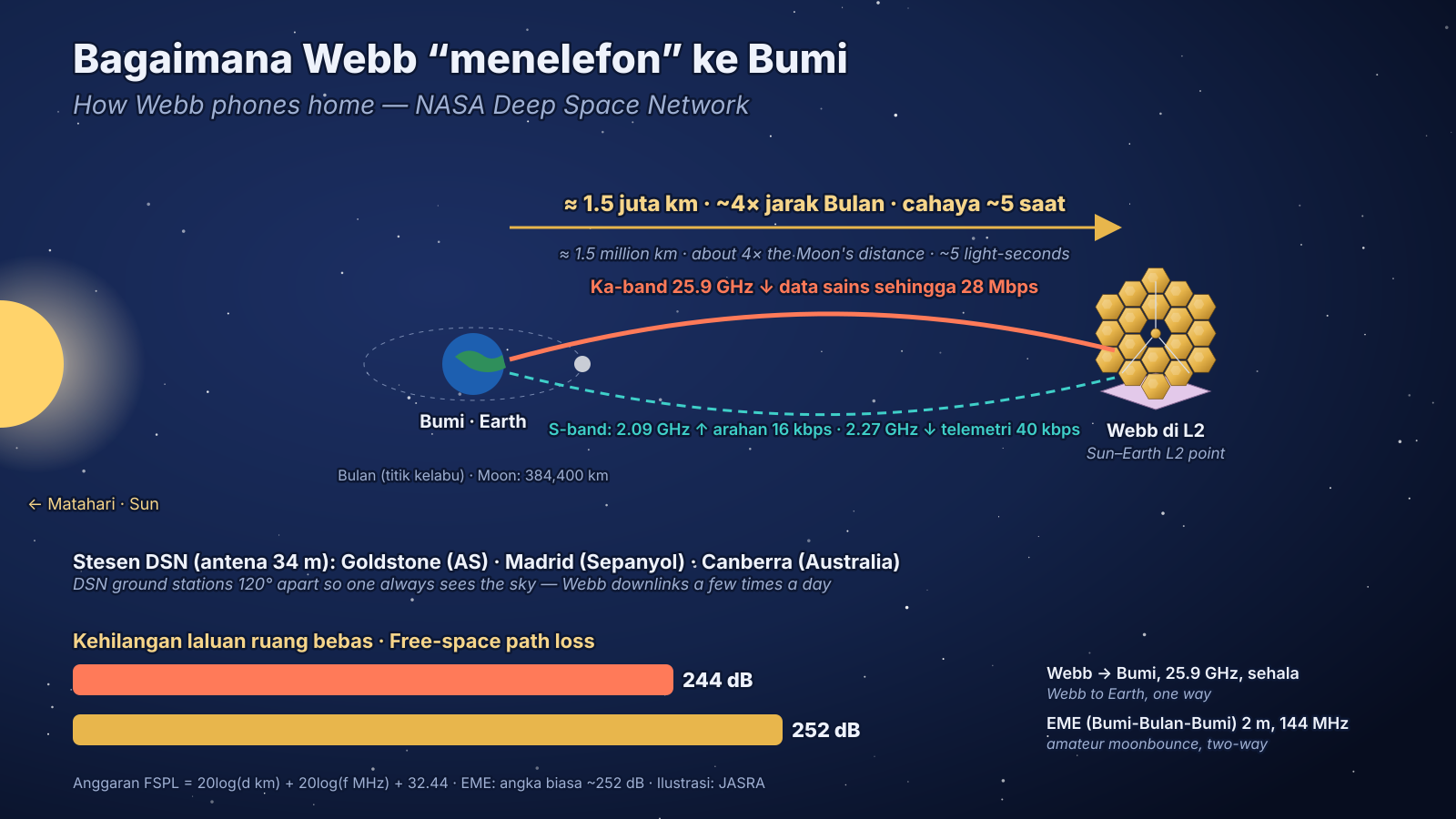
Webb tidak boleh “menghantar gambar” tanpa radio. Ia berkomunikasi dengan NASA Deep Space Network (DSN) — antena 34 meter di Goldstone (Amerika Syarikat), Madrid (Sepanyol) dan Canberra (Australia), yang dijarakkan kira-kira 120° supaya sentiasa ada satu stesen yang menghadap ke arah Webb.
- Ka-band 25.9 GHz — downlink data sains, sehingga 28 Mbps (puluhan gigabait sehari).
- S-band 2.09 GHz — uplink arahan dan jadual cerapan (16 kbps).
- S-band 2.27 GHz — downlink telemetri kejuruteraan (40 kbps).
Pada jarak 1.5 juta km, isyarat mengambil masa kira-kira 5 saat untuk sampai. Kehilangan laluan ruang bebas (FSPL) pada 25.9 GHz ialah lebih kurang 244 dB. Sebagai perbandingan, rakan-rakan EME (Bumi–Bulan–Bumi) di jalur 2 meter berdepan kira-kira 252 dB untuk pantulan dari Bulan — lebih besar lagi! Bezanya, Webb menghantar berjuta bit sesaat menggunakan antena gergasi DSN, manakala EME amatur berpuas hati dengan beberapa aksara CW atau JT65/Q65 seminit.
10. Apa yang boleh dicuba oleh ahli JASRA
- Dengar hidrogen galaksi kita sendiri — piring kecil atau antena tanduk, LNA 1.42 GHz dan dongle SDR murah sudah cukup untuk mengesan garis 21 cm dari Bima Sakti. Projek “amateur radio astronomy” yang hebat untuk kelab. Rujukan: Hydrogen line.
- Lihat siapa yang sedang bercakap dengan Webb — laman DSN Now menunjukkan secara langsung antena DSN mana yang sedang menerima data JWST, berserta frekuensi dan kadar data.
- Dengar Musytari — projek NASA Radio JOVE menggunakan penerima ringkas sekitar 20.1 MHz untuk mendengar letusan radio dari Musytari dan Matahari.
- Bincangkan di net mingguan — topik Doppler, FSPL dan f = c/λ di atas sesuai untuk sesi pembelajaran calon peperiksaan RAE.
Penutup
Webb tidak “mengumumkan” satu angka ajaib tentang saiz alam semesta. Apa yang ia lakukan lebih penting: setiap imej menunjukkan alam semesta yang lebih sesak, lebih awal matang dan lebih menakjubkan daripada jangkaan. Dan bagi kita yang bermain radio, ada satu kepuasan istimewa — sains paling canggih di dunia ini berdiri di atas asas yang sama dengan hobi kita: gelombang elektromagnet, frekuensi, antena dan isyarat yang lemah. 73!
The James Webb Telescope & the True Scale of the Universe — and what it has to do with radio waves
A popular article titled “James Webb Telescope Just Announced The True Scale of the Universe” has been widely shared. The headline is dramatic, and the core idea is true: since it began science operations in 2022, the James Webb Space Telescope (JWST) has changed how we see the size and history of the universe. Here we retell that story with checked facts, and — as an amateur radio society — we add one more angle: the light Webb sees is a close cousin of the radio waves we use every day on HF, VHF and UHF.
1. Webb at a glance
| Launch | 25 December 2021 on an Ariane 5 from Kourou, French Guiana (a NASA, ESA and CSA partnership) |
| Location | Sun–Earth Lagrange point L2, about 1.5 million km from Earth (≈4 times the distance to the Moon) |
| Primary mirror | 6.5 m, 18 gold-coated beryllium segments (gold reflects infrared extremely well) |
| Sunshield | 5 layers, about the size of a tennis court (≈21 m × 14 m) |
| Operating temperature | Below −223 °C; the MIRI instrument is cooled to about −266 °C (7 K) |
| “Eyes” | Infrared, 0.6–28.5 micrometres (µm) — roughly 500 THz down to 10.5 THz |
Why infrared? Light from the most distant galaxies has been stretched on its way across the expanding universe, so ultraviolet and visible light arrive as infrared. Webb must be extremely cold so that its own heat does not blind its detectors — just as a receiver needs a low-noise amplifier (LNA) to hear a weak signal.
2. “A grain of sand at arm’s length”: Webb’s First Deep Field
On 12 July 2022 the world saw Webb’s first full-colour image: the galaxy cluster SMACS 0723. The patch of sky it covers is only about the size of a grain of sand held at arm’s length — yet it is crowded with thousands of galaxies. We see the cluster as it was 4.6 billion years ago, and its huge mass acts as a magnifying glass (a gravitational lens), bending and enlarging the light of far older galaxies behind it. The image took about 12.5 hours of observing — a depth that took earlier telescopes weeks.
3. The distance record: MoM-z14
Webb keeps breaking its own records. In 2024 the galaxy JADES-GS-z14-0 was reported as the most distant known. Then galaxy MoM-z14 was confirmed with the NIRSpec instrument at a redshift of z = 14.44: its light has travelled for about 13.5 billion years, and we see it when the universe was only about 280 million years old. According to the research team, bright galaxies like this are about 100 times more common in the early universe than theory predicted before Webb launched. That is the real surprise: the Big Bang is not wrong, but our models of how quickly the first stars and galaxies formed need updating.
4. The true scale: 13.8 billion years old, 93 billion light-years across
The universe is about 13.8 billion years old. So how can the observable universe be about 93 billion light-years across? Because space itself kept expanding while the light was travelling. Light that set out 13.8 billion years ago came from matter that is now about 46.5 billion light-years away (the radius), giving a diameter of ≈93 billion light-years. And that is only the part we can see — the whole universe may be far larger, perhaps infinite.
5. So how many galaxies are there?
The original article says “trillions, not 200 billion”. The real story is more interesting: in 2016 a study based on Hubble data estimated up to 2 trillion galaxies in the observable universe; in 2021, measurements of the sky’s background glow by the New Horizons spacecraft suggested the number may be “only” a few hundred billion. Webb now counts very faint, distant galaxies directly, helping to settle the difference. There is no final answer yet — but whatever the number, each galaxy holds billions of stars. It is also a good example of how science works: estimates improve as instruments improve.
6. What has this to do with radio? One family of waves
For radio amateurs, this is the fun part. Light, infrared and radio are the same electromagnetic waves, travelling at the speed of light (c ≈ 300,000 km/s). Only the frequency and wavelength differ, linked by the formula we all use to cut antennas:
f = c / λ · e.g. 300 / 145 MHz ≈ 2.07 m (the 2-metre band)
Webb’s NIRCam observes around 2 micrometres — exactly a million times shorter than our 2-metre band, roughly 150 THz versus 145 MHz. Same physics, just a different spot on the dial.
7. Redshift = the Doppler effect we already know
Anyone who has worked a satellite or the ISS knows Doppler shift: the ISS downlink on 145.800 MHz moves by up to about ±3.5 kHz during a pass, because the station is racing towards and then away from us. Cosmological redshift is a close cousin — except that it happens because space itself expands and stretches the wave. The formula is simple: λ received = λ emitted × (1 + z).
- For MoM-z14 (z = 14.44), ultraviolet Lyman-alpha light at 121.6 nm is stretched 15.44 times to about 1.88 µm (infrared). Hubble cannot see it; Webb can.
- The radio astronomer’s favourite line, neutral hydrogen at 1420.405 MHz (21 cm), from that same era would reach Earth at about 92 MHz — right inside the FM broadcast band!
- Hydrogen from roughly 600 million years after the Big Bang (z ≈ 8.8) arrives near 145 MHz — in our own 2-metre band.
That is why new radio telescopes such as SKA-Low (50–350 MHz, more than 130,000 antennas in Western Australia — the same time zone as Malaysia, UTC+8) are built in radio-quiet zones. These ancient hydrogen signals are far weaker than FM and TV transmitters — and our own rigs. The 1400–1427 MHz band is protected internationally by the ITU: no one may transmit there, for the sake of radio astronomy.
8. The oldest light was found with a radio antenna
Another story close to every radio amateur’s heart: in 1964–65, two Bell Labs scientists, Arno Penzias and Robert Wilson, found a mysterious “noise” at 4.08 GHz in their horn antenna. It came from every direction, day and night. It turned out to be the Cosmic Microwave Background (CMB) — the oldest light in the universe, released 380,000 years after the Big Bang and now stretched into microwaves (peaking around 160 GHz). They received the 1978 Nobel Prize in Physics. A small part of the “snow” on an old analogue TV screen was actually this echo of the Big Bang!
9. How Webb sends its data home
Webb cannot “send pictures” without radio. It talks to the NASA Deep Space Network (DSN) — 34-metre dishes at Goldstone (USA), Madrid (Spain) and Canberra (Australia), spaced about 120° apart so one station can always see Webb.
- Ka-band 25.9 GHz — science data downlink, up to 28 Mbps (tens of gigabytes a day).
- S-band 2.09 GHz — uplink for commands and observing schedules (16 kbps).
- S-band 2.27 GHz — engineering telemetry downlink (40 kbps).
At 1.5 million km, the signal takes about 5 seconds to arrive. The free-space path loss (FSPL) at 25.9 GHz is about 244 dB. For comparison, EME (Earth–Moon–Earth) operators on 2 metres face about 252 dB for a bounce off the Moon — even more! The difference is that Webb moves millions of bits per second into the DSN’s giant dishes, while amateur EME is happy with a few CW characters or a JT65/Q65 message per minute.
10. Things JASRA members can try
- Hear the hydrogen of our own galaxy — a small dish or horn antenna, a 1.42 GHz LNA and a cheap SDR dongle are enough to detect the 21 cm line from the Milky Way. A great club project in amateur radio astronomy. Reference: Hydrogen line.
- See who is talking to Webb — DSN Now shows live which DSN dish is receiving JWST, with frequency and data rate.
- Listen to Jupiter — the NASA Radio JOVE project uses a simple receiver near 20.1 MHz to hear radio storms from Jupiter and the Sun.
- Use it on the weekly net — Doppler, FSPL and f = c/λ make a good study session for RAE exam candidates.
Final thoughts
Webb did not “announce” one magic number for the size of the universe. What it does is more important: every image shows a universe that is more crowded, matured earlier, and is more wonderful than we expected. And for those of us in radio there is a special satisfaction — the world’s most advanced science stands on the same foundations as our hobby: electromagnetic waves, frequency, antennas and weak signals. 73!
Kredit & rujukan · Credits & references
- Artikel asal / Original article: “James Webb Telescope Just Announced The True Scale of the Universe” — blog.sciandnature.com. Ditulis semula dan disemak fakta; beberapa angka dikemas kini mengikut penerbitan rasmi, dan petikan yang tidak dapat disahkan tidak diulang. · Rewritten and fact-checked; some figures were updated to match official releases, and quotes we could not verify were left out.
- Imej / Images: ESA/Webb, dilesen di bawah / licensed under CC BY 4.0 — Webb’s First Deep Field (NASA, ESA, CSA, and STScI); MoM-z14 (NASA, ESA, CSA, STScI, R. Naidu (MIT), Image Processing: J. DePasquale (STScI)); Webb in the cleanroom (NASA/Chris Gunn). Saiz diubah sahaja / resized only.
- Ilustrasi lain dilukis khas untuk artikel ini / Other illustrations drawn for this post: JASRA.
- Rujukan / References: NASA Webb mission · ESA/Webb first images · ESA/Webb MoM-z14 release · ESA/Hubble: 2 trillion galaxies (2016) · NASA: Talking with Webb using the DSN · SKAO: SKA-Low.
Artikel ini disediakan dengan bantuan pembantu AI dan disemak berdasarkan sumber rasmi NASA/ESA (setakat November 2026). · This article was prepared with the help of an AI assistant and checked against official NASA/ESA sources (as of November 2026). Kiraan FSPL dan anjakan frekuensi ialah anggaran pendidikan. · FSPL and frequency-shift figures are educational estimates.


