



Ringkasan (BM): CQ WW DX Contest 2026 — SSB pada 24–25 Oktober dan CW pada 28–29 November (00:00–23:59 UTC). Kontes DX terbesar dunia ini terbuka kepada semua pengendali radio amatur berlesen, termasuk di Malaysia (CQ Zon 28). Baca panduan ringkas di bawah, dan hantar log Cabrillo anda sebelum tarikh akhir.
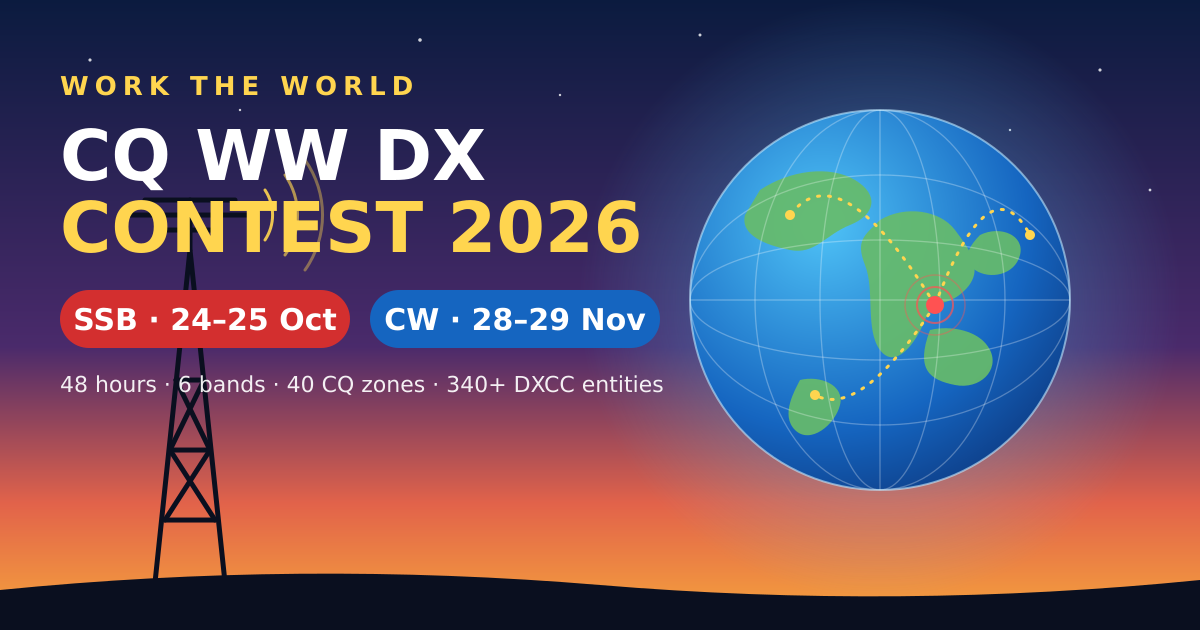
Every year, on the last full weekends of October and November, tens of thousands of radio amateurs on every continent fill the HF bands with a single goal: contact as many countries and CQ zones as possible in 48 hours. That event is the CQ World Wide DX Contest — often called simply “CQ WW” — and in 2026 it is happening right now. The SSB (phone) leg starts today, 24 October. If you hold a valid licence, you can join with whatever station you have, even for an hour.
1. Dates and times
| Mode | Start (UTC) | End (UTC) | Malaysia time (UTC+8) | Log deadline |
|---|---|---|---|---|
| SSB | Sat 24 Oct 00:00 | Sun 25 Oct 23:59 | 24 Oct 08:00 – 26 Oct 07:59 | 27 Oct 2026, 23:59 UTC |
| CW | Sat 28 Nov 00:00 | Sun 29 Nov 23:59 | 28 Nov 08:00 – 30 Nov 07:59 | 1 Dec 2026, 23:59 UTC |
Tip: always log in UTC. Malaysia is UTC+8, so the contest begins at 8 a.m. local time on Saturday and ends at 8 a.m. on Monday.
2. The six contest bands
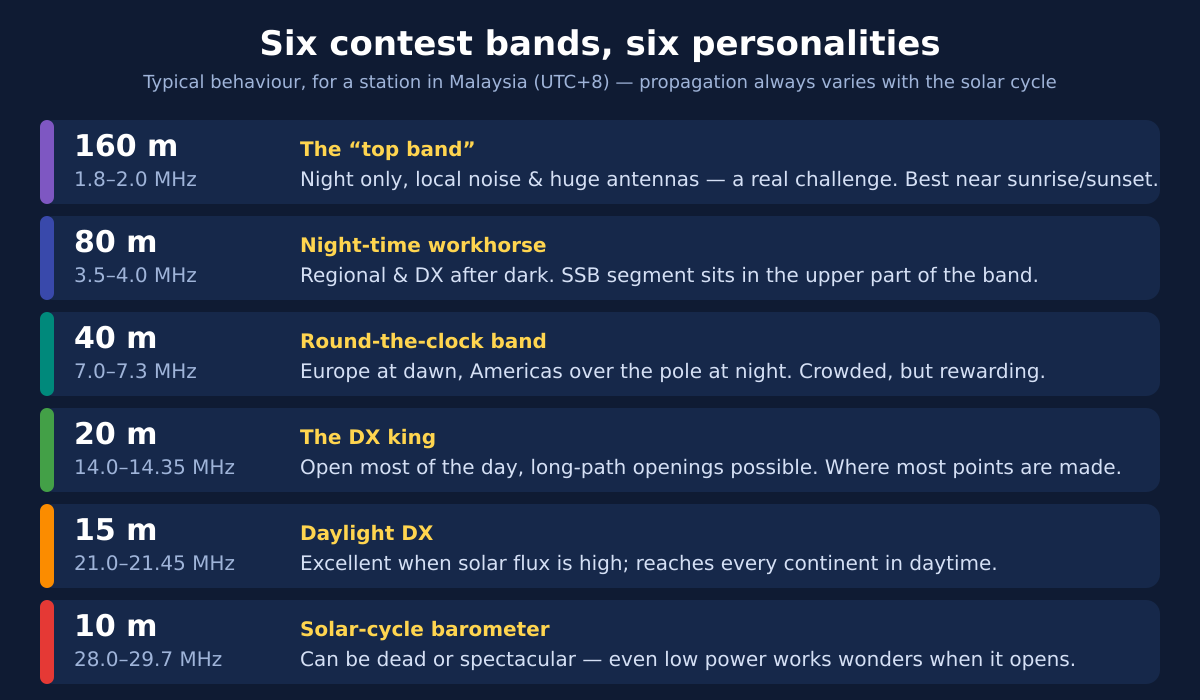
Only the classic bands 160, 80, 40, 20, 15 and 10 m are used. The WARC bands (30, 17 and 12 m) are not allowed in this contest. Always stay inside the segments and privileges of your own Malaysian licence class (see the MCMC regulations).
3. The exchange: very short and simple
- SSB: RS report + your CQ zone — for Malaysia that is 59 28.
- CW: RST report + CQ zone — 599 28.
Both Peninsular and East Malaysia are in CQ Zone 28. A typical SSB exchange sounds like this:
“CQ Contest, CQ Contest, 9W2ABC.” — “JA1XYZ.” — “JA1XYZ, five nine twenty-eight.” — “Five nine twenty-five.” — “Thank you, 9W2ABC contest.”
(The callsigns above are examples only.) Never use someone else’s zone by guesswork: the CQ zone list and the DXCC country list are the reference for multipliers.
4. How scoring works
Your final score is total QSO points × (CQ zones + countries), with multipliers counted separately on each band. For a station in Asia, such as Malaysia:
- Contact on a different continent: 3 points
- Different country on the same continent (Asia–Asia): 1 point
- Same country: 0 points — but it still counts for the multipliers
- Within North America, different countries: 2 points
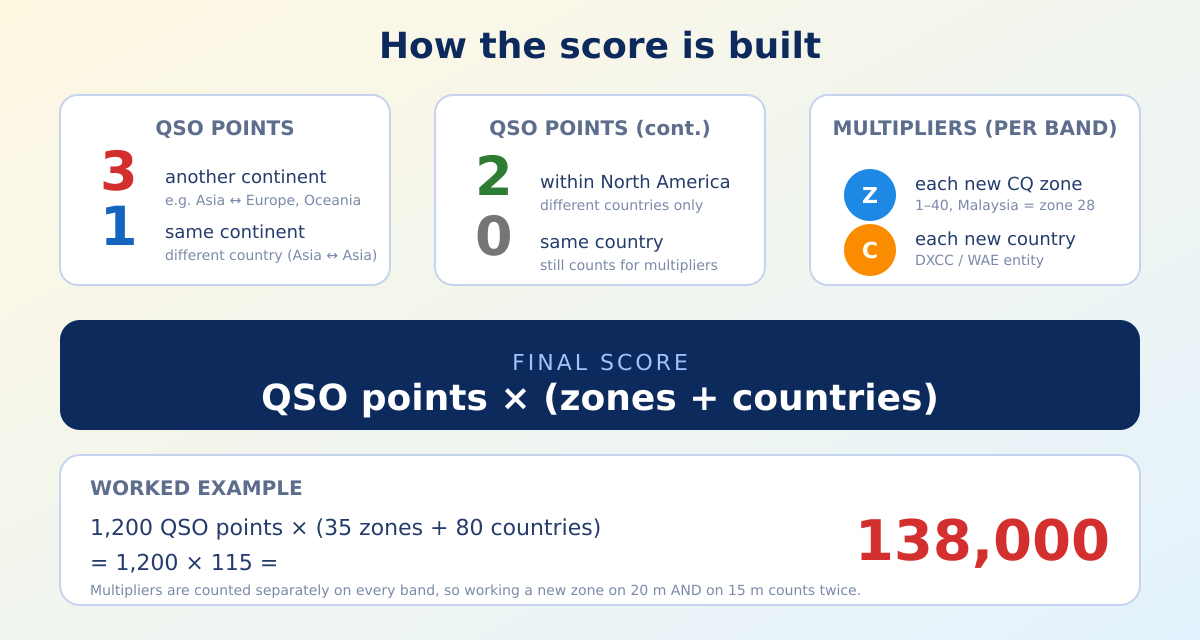
This is why a few hard-won contacts with Europe or the Americas are worth far more than many easy local QSOs: three points each, and every new zone or country multiplies your entire score.
5. Choose your category
There is a place for every station, from a 5-watt portable rig to a multi-transmitter club station.
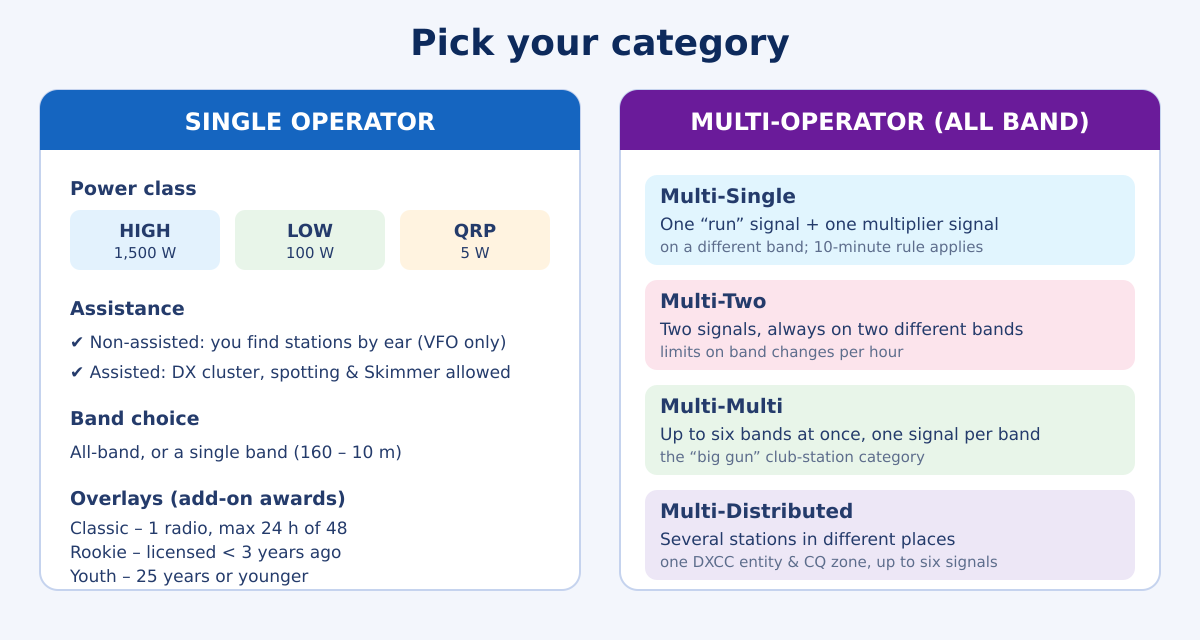
- Power: High Power (up to 1,500 W), Low Power (100 W) and QRP (5 W). These are contest limits, not permission to exceed what your Malaysian licence allows.
- Non-assisted vs Assisted: in the non-assisted classes you must find stations yourself — no DX cluster, no spotting websites, no CW Skimmer or Reverse Beacon Network. Assisted entries may use them.
- Classic overlay: one radio, no assistance, a maximum of 24 hours operated out of the 48, with off-times of at least 60 minutes.
- Rookie overlay: first licensed less than three years before the contest. Youth overlay: aged 25 or younger. Both are excellent ways for newcomers to get recognised.
- Multi-operator classes (all-band only): Multi-Single, Multi-Two, Multi-Multi and Multi-Distributed. Ideal for club stations — a great project for a society activity.
6. The rules that catch people out
- No self-spotting, and no asking others to spot you.
- No arranging contacts via the internet, phone, WhatsApp or social media — every QSO must be made over the air.
- No remote receivers outside your station location, and no automated “robot” operation.
- Stay within the power limit of your category — measured at the output of the amplifier.
- Do not edit your log with a database or lookup after the contest ends.
- Do not make more than three consecutive QSOs without sending your own callsign.
Read the complete, official CQ WW rules before the contest — and again before you submit your log.
7. Tools and practical tips
- Logging software: N1MM Logger+ (Windows), or any contest logger that exports Cabrillo; it handles dupes, zones and multipliers for you.
- Find the best bands: watch the Reverse Beacon Network and DX Summit for propagation hints — but remember that using them in an unassisted category is not allowed during the contest itself, so practise beforehand.
- Look up callsigns: HamQTH, and check DX Watch or DXCC lists to know what each country counts for.
- Start with low expectations, finish with a big smile: even 30 minutes of casual operating produces new countries and zones for your log. Many first-time contesters simply “search and pounce” on 20 m and 15 m for a couple of hours.
- Look after yourself: water, food, breaks and a decent chair matter more than another antenna.
- Check the calendar for other contests this season at the WA7BNM Contest Calendar.
8. Submitting your log
Logs must be in Cabrillo format and uploaded through the official CQ WW log checking page. Each QSO line needs the UTC date and time, band or frequency, callsign, and both exchanges sent and received. Deadlines:
- SSB: 27 October 2026, 23:59 UTC (28 October, 07:59 Malaysia time)
- CW: 1 December 2026, 23:59 UTC (2 December, 07:59 Malaysia time)
Even a small log is useful: it helps other stations get credit for their contacts with you. After the results are published, the public logs are a fascinating way to learn how the top stations operated.
9. The real goal
Scores and certificates are nice, but the heart of CQ WW is simple: make contacts across the world, from as many countries and zones as possible, and enjoy the hobby. Good luck, work the world — and 73!
This article was prepared with the help of an AI assistant and reviewed against the official CQ WW rules on cqww.com (as of 24 October 2026). Rules and deadlines can change — always check the official rules page. Illustrations were created for this post.


